

How BookBub Ads Are Working For Me
How does a 26.6% conversion rate sound?

A couple of months ago I decided to take a different approach to my advertising campaigns.
First, I stopped every campaign except my Amazon brand protection ads (they’re critical to ensure readers searching for my books on Amazon find only me, rather than someone else). They don’t cost much and don’t generate many sales on their own.
However, every other ad, was stopped.
I had one aim in mind: to strip my advertising efforts to the ground to see the true impact of a CPC BookBub campaign, without any noise from elsewhere.
Although, consequently, my sales dwindled to nothing, the results since have been mind-blowing.

As some background, I’ve a single Bookbub campaign focusing solely on my first in a fifteen book crime series at a lowly budget of $5 / day (you can run an ad from as little as $1 / day), targeting a single competitor author in the UK only. And my campaign has been running for seven days (from 21st August).
These are my actual sales on the promoted novel over the period (downloads only, I’ve excluded page reads):
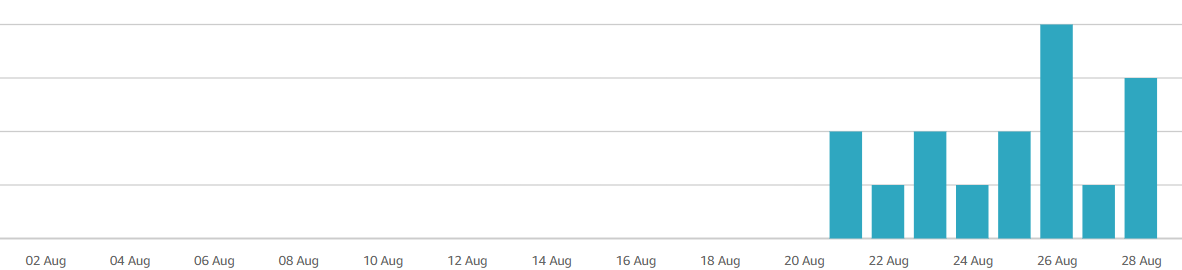
What I see is the impact of BookBub: an immediate impact on downloads - right from out the gate.
Why BookBub Looks Expensive
BookBub has a reputation for being a costly platform, And, if I only look at cost-per-click (CPC) it is. On Facebook, I might pay between 15p and 25p (genre dependant, some can be much lower). On Amazon, it could be 20p to 30p.
On BookBub, my clicks have been coming in at around 50p (some days a touch higher, others a little lower). At first glance, this looks like a terrible deal. Why pay BookBub for clicks when other platforms are offering the same for half the price? I’d have to be nuts, right?
It’s this headline figure that makes many authors hesitate before testing BookBub. However, CPC alone doesn’t tell me the whole story. CPC only reveals what I’m paying for people to look at my ad. I really want to know if people are buying because of the ad.
Why Conversion Rate Matters More
This is where conversion comes in.
To calculate conversion divide the number of downloads by the number of clicks. That’s all.
My BookBub campaign has been converting at a whopping 26.6%. In simple terms, that means more than one in four people who clicked on the ad bought my book.
In comparison, the conversion rate on Facebook may be 2 - 3% (I’m not kidding) and Amazon, 5 - 8%.
This difference changes everything. Because if four times as many clicks convert into sales, then a higher CPC is more than compensated for, particularly if a reader then trundles through fourteen more books.
A Worked Example
Let’s take a simple comparison as a comparative example (genre makes a huge difference here). Imagine spending £50 on each platform.
Facebook
Average CPC: £0.20
£50 buys 250 clicks
Conversion rate: 5% (1 in 20)
Sales: 12 or 13
Cost per sale: about £4
Amazon
Average CPC: £0.25
£50 buys 200 clicks
Conversion rate: 10% (1 in 10)
Sales: 20
Cost per sale: £2.50
BookBub
Average CPC: £0.50
£50 buys 100 clicks
Conversion rate: 26.6% (roughly 1 in 4)
Sales: 26 or 27
Cost per sale: about £1.90
I’m well aware these numbers are generic and differ for every author, but the illustration holds. BookBub converts better and so is overall cheaper.
Why BookBub Converts Better
The reason BookBub performs this way is staggeringly straightforward. BookBub’s audience is made up entirely of readers. More than 15 million of them have signed up with a single purpose in mind: to find new books.
Which makes BookBub very different to Facebook, where people are there for socialising, or Amazon, where readers are just one part of a much larger shopping audience. On BookBub, every click is from someone who is already in a reading mindset. That’s why the conversion rate is so much stronger.
For me, seeing a conversion rate of 26.6% has been mind-blowing (I’m well aware that not all campaigns will generate this kind of return, but still!).
I now know my ad is reaching the right people and that once they land on the book page, the description, cover, and reviews are doing their job - my Amazon product page works.
What’s Next
Seven days with one ad in one region is just the beginning.
Although it’s blindingly obvious I’ll be keep the current campaign going to see how the numbers hold over a longer stretch.
Next, I plan to test the same creative with different targeting options and running the existing creative in the US.
But already, this experiment has confirmed something important. BookBub may look expensive at first glance, but once I factor in conversion, for me it’s the most cost-effective option of all.
Want to learn more about building your own BookBub campaign?
Stay tuned as I’ll be putting out more on BookBub ads in the coming weeks.